
10yard
10 Yard Dumpster
- about 14 ft long × 7.5 ft wide × 3.5 ft high
- about 50-70 kitchen-size trash bags
- Weight, with the box still half empty
Concrete, block, tile, dirt and roof tear-off.
See the 10 yardCompare sizes
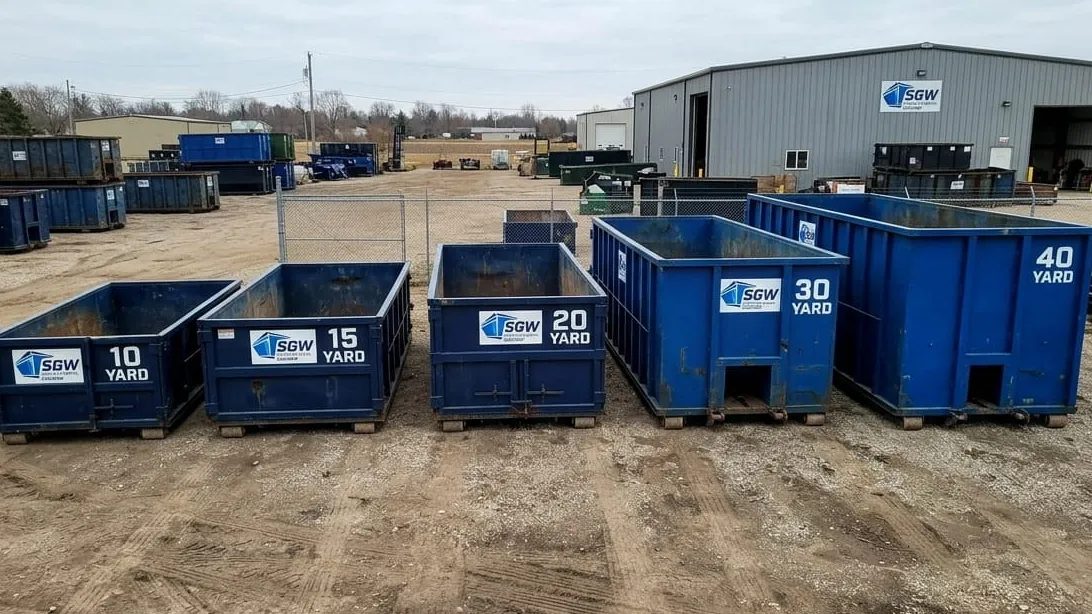
Five roll-off containers, and a straight answer about which of the two limits your material is going to reach first.
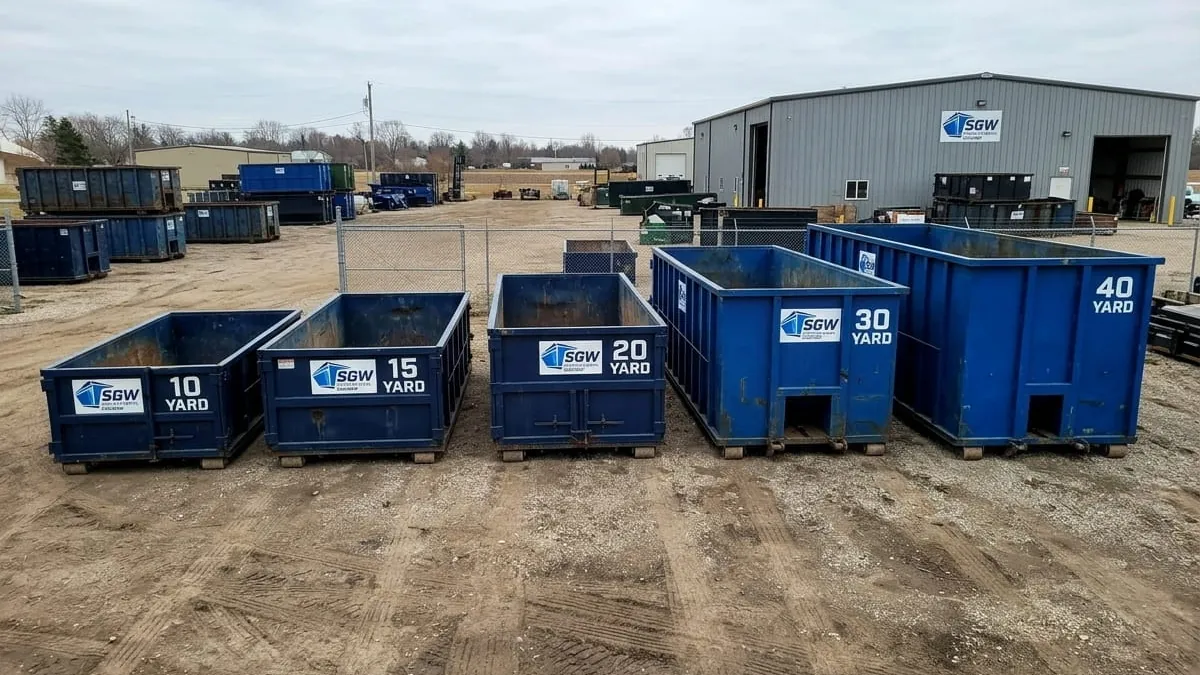
A roll-off has a size measured in cubic yards, and the loaded truck has a weight it can lawfully carry on a public road. Those are two separate ceilings with two separate owners, and the only thing that decides which one you arrive at is what goes in the box. A house being emptied of furniture, bagged goods and cardboard runs out of room. Broken concrete, brick, plaster, tile, roof tear-off and clay that has had a wet week on it run out of road, usually with a good deal of the box still showing. Ordering on cubic yards alone is the mistake we spend most of our phone time heading off.
Which is why ordering the 40 yard is not the cautious move. The extra height is room, and room is no use to rubble. Dense material usually wants a 10 yard taken only part of the way up; bulky light material is the one case where sizing up earns its keep. The piece that works through it properly is why weight decides the size in Saginaw County.
One thing more, because it is where a lot of these calls start. Inside the City of Saginaw, Code § 50.06(C) lists “stones, bricks, plaster, shingles, lumber, demolition materials, building materials, concrete, sand, gravel, and earth” among the things the City’s collection will not take, and § 50.06(I) adds “material resulting from contract work.” Chapter 50 is current through Ordinance O-274, passed 22 September 2025 and effective 2 October 2025. That is a statement about what the City will not collect, not an instruction to anybody, and those are City sections that stop at the city line.
Comparison
The dimensions are external measurements of the box and they are approximate: manufacturers build to slightly different sizes, and the three figures deliberately do not multiply out to the yardage in the name. The yardage is the trade name for the size rather than a computed internal volume, so compare the boxes on it and then tell us what is going in. Tell us the run you have and we will work the access out with you rather than from the table.
| Size | Dimensions | Capacity | What fills it first | Best for |
|---|---|---|---|---|
| 10 Yard Dumpster | about 14 ft long × 7.5 ft wide × 3.5 ft high | about 50-70 kitchen-size trash bags | Weight, with the box still half empty | Concrete, block, tile, dirt and roof tear-off. |
| 15 Yard Dumpster | about 16 ft long × 7.5 ft wide × 4.5 ft high | about 80-100 kitchen-size trash bags | Usually weight, on a mixed load | Garage clearing, flooring tear-out and one heavy room. |
| 20 Yard Dumpster | about 22 ft long × 7.5 ft wide × 4.5 ft high | about 110-130 kitchen-size trash bags | Either, depending what goes in | Most remodels, and a house being emptied room by room. |
| 30 Yard Dumpster | about 22 ft long × 7.5 ft wide × 6 ft high | about 170-190 kitchen-size trash bags | Volume, on bulky light material | Multi-room work and a full estate clearance. |
| 40 Yard Dumpster | about 22 ft long × 7.5 ft wide × 8 ft high | about 230-250 kitchen-size trash bags | Volume, almost always | New construction and bulky demolition waste. |
The sizes
Concrete, block, tile, dirt and roof tear-off.
See the 10 yardGarage clearing, flooring tear-out and one heavy room.
See the 15 yardMost remodels, and a house being emptied room by room.
See the 20 yardMulti-room work and a full estate clearance.
See the 30 yardNew construction and bulky demolition waste.
See the 40 yardBy project
Talk to a real person
Tell us the material, the access, and which of the seventeen communities the address sits in, and we will say which box we would send. Where we could not establish a local rule you will hear that too. Call (989) 272-9034.
Call and ask what the board looks like today
Answers
Five of them, running from the 10 yard up to the 40. Most of a house being emptied lands on the 20. Concrete, block, tile and clay spoil belong in the 10, because dense material arrives at the lawful road weight for a loaded truck while a good part of the box is still showing. The 40 buys you room for material that takes up space without weighing much. It does not buy you weight.
It is fixable in both directions. If the box turns out too small once the room is actually opened up, we can arrange a swap, and we would far rather arrange one than have you guess on the phone. Going the other way, an oversized box on a dense load buys you nothing, because the ceiling you reach belongs to the public road rather than to the top rail. Describe the material and we will steer you.
Think of it as the length of the box plus the room the truck needs to tilt it off and hook it back on, with nothing overhead where the arm travels. We do not publish a figure in feet for any of the five sizes, because the only run that decides anything is the one at your address, so describe the approach and we will work it out with you. Overhead lines, low limbs and the short drives on some of the older City streets stop more deliveries around here than anything to do with the container.
Because the two ceilings belong to different places. Cubic yards describe the steel. What the loaded truck can lawfully carry on a public road describes the road, and the road does not care how much air is left above the load. Broken concrete, brick, plaster, tile and rain-heavy clay get there early; furniture, bagged household goods and cardboard almost never do. That is the whole reason we ask what is going in before anyone talks about size.
The 10, 15 and 20 go almost anywhere with a driveway. The 30 and the 40 want a longer straight approach and are not always practical on a tight older street with no off-street parking. Ground matters as much as length: firm dry ground carries a loaded container, and ground softened by a wet week or moving through freeze and thaw does not. Plywood goes under the wheels and both rails as standard. We are not qualified to assess the ground at your address and we will say so rather than reassure you.
Service area
We run containers out of 3102 Sawyer Dr to seventeen communities in Saginaw County. They are grouped below by what kind of government each one actually is, because in Michigan that is the difference between a city hall, a township board and a village that sits inside a township — and it decides who you have to call about your own address. If yours is not listed, call anyway; we most likely still get there.
The only jurisdiction in this list whose refuse rules we were able to read and quote.
A township board, not a city hall. We could not establish container or refuse rules for any of these, and we do not publish ones we could not read.
Two cities and two villages. A village sits inside its township, so a village address has two governments over it at once.