
Saginaw County service
Commercial Dumpster Rental in Saginaw, MI
Containers and swap-outs for shops, restaurants, offices, trades and property managers, on whatever cadence the work actually runs at rather than a fixed collection day.
- City ordinance quoted by section
- 17 communities, 19 governments
- Call-only — no quote form
- We say what we could not verify
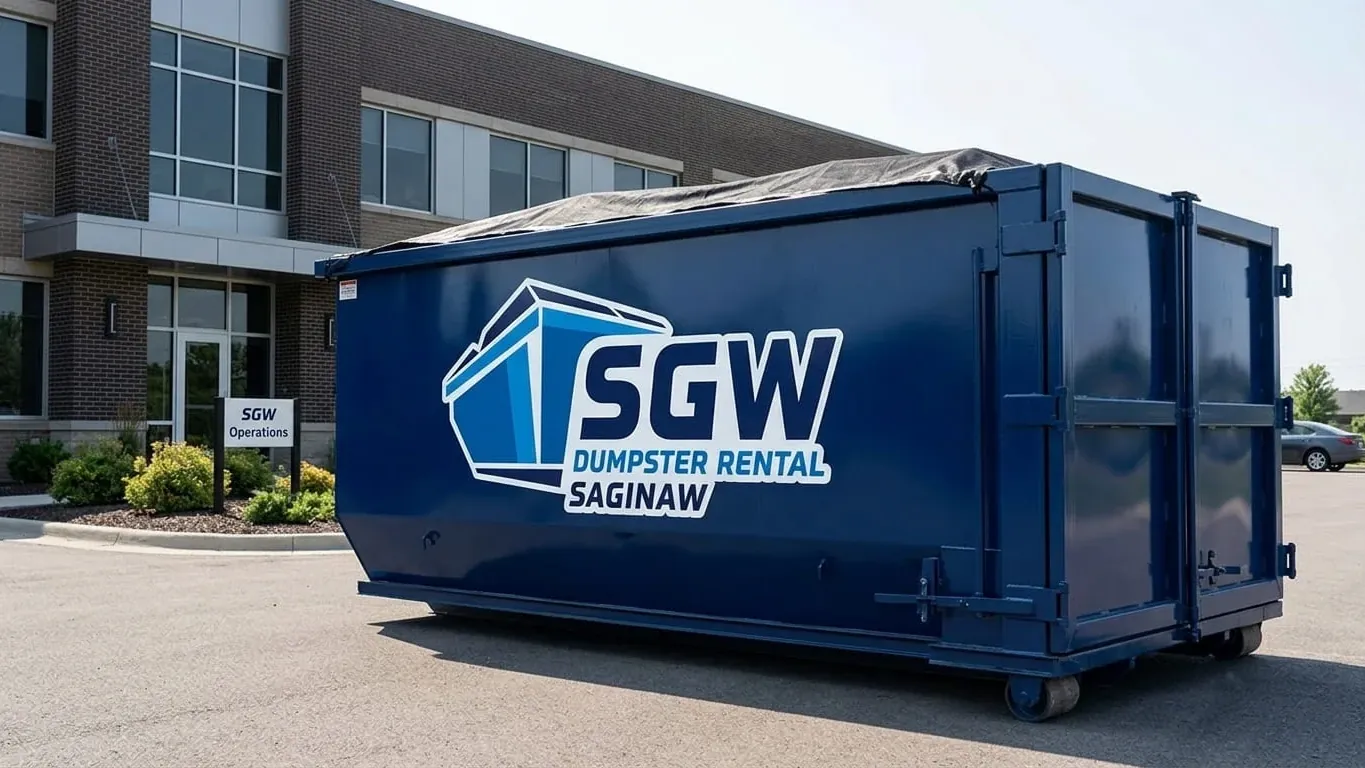
Commercial Dumpster Rental across Saginaw County
There is one subsection of the City of Saginaw's refuse ordinance that does more work for a business reader than any other. Section 50.06(I) says the City's collection will not pick up “material resulting from contract work,” and the ordinance gives its own examples: “landscaping, tree trimming, construction or demolition, or work done by utility companies.” That single phrase covers most of what leaves a commercial premises when something is being built, stripped, replaced or cleared, and it is in the code rather than in a policy letter.
Alongside it, Section 50.06(C) excludes “stones, bricks, plaster, shingles, lumber, demolition materials, building materials, concrete, sand, gravel, and earth.” Between the two, a shop fit-out, a restaurant refurbishment and a property turnover all sit outside what the curb was designed to absorb. A container that stays on site and gets swapped when it is full is simply the arrangement that matches the way the work generates waste — in bursts, on the job's clock, not in weekly increments.
Chapter 50 is current through Ordinance O-274, passed 22 September 2025, effective 2 October 2025, and the text is public in the City of Saginaw Code of Ordinances. It governs the City. It does not govern the sixteen other communities on our list.
At a glance
What you get with commercial dumpster rental
- Containers that stay on site and get swapped when the work fills them
- Cadence set by the job rather than by a fixed collection day
- Straight answers about what the law treats differently for a business
- One point of contact on the phone for a multi-building portfolio
“Material resulting from contract work”, and why the phrase is so wide
Most exclusions in a refuse ordinance are about a substance. Section 50.06(I) is about an origin. It does not ask what the material is; it asks where it came from. If a contractor generated it, it falls in the subsection, and the examples the ordinance itself offers are broad: landscaping, tree trimming, construction or demolition, and work done by utility companies.
For a business, that reaches further than it first looks. A landlord who hires a crew to strip a unit between tenants has contract-work debris. A restaurant replacing a line and a floor has contract-work debris. A property manager clearing an overgrown lot through a landscaper has contract-work debris, even though the material is leaves and branches. The nature of the pile is not what decides it.
Two cautions, because the subsection is easy to overstate. First, this is the City's ordinance, and it describes what the City's collection will not take. It does not require anybody to rent a container; what you do instead is an operational decision. Second, Section 50.06 does not mention appliances, stumps or bulky items anywhere, so we do not claim it excludes them. Where the ordinance is silent, we say it is silent.
One waste authority, many governments
Here is the fact that explains why the rules feel simpler than they are. The City of Saginaw, Saginaw Charter Township, Buena Vista Charter Township and thirty-one other municipalities are all members of the Mid Michigan Waste Authority, a 34-member body that organizes residential waste services across the greater Saginaw area. One institution, one set of familiar carts and programs, one website. From the curb, it looks like a single system.
It is not a single rulebook. Saginaw County has thirty county subdivisions — three cities and twenty-seven townships — plus five villages inside townships, and each of those is a government that writes its own ordinances. Sharing a waste authority is not the same as sharing a refuse chapter. We read the City of Saginaw's chapter and can quote it by section. We did not read any other community's, and we will not reconstruct one from the general shape of Michigan practice.
There is a further wrinkle a multi-site operator should know about. EGLE's own hauler guidance states that “hauling between counties must be allowed under both counties' Solid Waste Management Plans.” The county line is therefore not decorative. If your portfolio crosses it, that is a question worth raising when you call rather than discovering later.
What the State actually asks of a solid waste hauler
This is where a national template usually overclaims, so it is worth stating what Michigan's environmental agency says in its own words. EGLE's published hauler requirements document states that “the solid waste regulations do not require a license, permit, or registration from EGLE to haul solid waste.” There is one stated exception in that document: “if more than ten scrap tires will be picked-up, a scrap tire hauler registration is required.” Ten is the trigger, and it is a real number rather than a formality.
EGLE does impose operating duties. The unit design must prevent any of the waste from being spilled, with covers and latches where odors, vermin, liquids, dust or smoke need controlling. Spill records are kept for at least three years and a written report follows within thirty days of a release. And there is a customer-facing duty that explains why a page like this exists at all: haulers must annually inform customers about landfill-banned wastes.
We are describing the law, not our own paperwork. Vehicle and driver licensing sits with the Secretary of State, not with EGLE, and the material restrictions sit with Part 115 of NREPA. Where a rule turns on something specific to your site or your material, the honest answer is to ask the agency, and we will say so rather than guess.
Suitability
When commercial dumpster rental is the right call, and when it is not
Read both columns against what is actually going to come out of the building before anything is booked. It is a short job and it decides the size.
Good fits for this container
- Retail and restaurant fit-outs, refurbishments and equipment swaps
- Property managers turning units between tenants
- Office and warehouse clear-downs, including fixtures and shelving
- A container that stays on a running job and gets swapped as it fills
Send these somewhere else
- Hazardous waste from a business or institution, which goes to a hazardous waste facility
- Bulk liquids from a business, which Michigan requires to be solidified before landfill disposal
- Routine weekly household refuse service, which is a curbside program
Sizing
Container sizes that run on commercial dumpster rental
Every size below runs on this service. Choose on the density of the material and the cubic yards look after themselves, because what ends a dense load is the weight the loaded truck can lawfully carry on a public road.
- 15 yard — A single unit turnover, or a small retail strip-out with fixtures and flooring.
- 20 yard — The usual working size for a fit-out or a mid-size refurbishment.
- 30 yard — Bulky, light commercial waste: shelving, partitioning, packaging, office furniture.
- 40 yard — High-volume light material on a long-running site, where volume rather than weight fills the box.
| Size | Dimensions | Capacity | What fills it first | Best for |
|---|---|---|---|---|
| 10 Yard Dumpster | about 14 ft long × 7.5 ft wide × 3.5 ft high | about 50-70 kitchen-size trash bags | Weight, with the box still half empty | Concrete, block, tile, dirt and roof tear-off. |
| 15 Yard Dumpster | about 16 ft long × 7.5 ft wide × 4.5 ft high | about 80-100 kitchen-size trash bags | Usually weight, on a mixed load | Garage clearing, flooring tear-out and one heavy room. |
| 20 Yard Dumpster | about 22 ft long × 7.5 ft wide × 4.5 ft high | about 110-130 kitchen-size trash bags | Either, depending what goes in | Most remodels, and a house being emptied room by room. |
| 30 Yard Dumpster | about 22 ft long × 7.5 ft wide × 6 ft high | about 170-190 kitchen-size trash bags | Volume, on bulky light material | Multi-room work and a full estate clearance. |
| 40 Yard Dumpster | about 22 ft long × 7.5 ft wide × 8 ft high | about 230-250 kitchen-size trash bags | Volume, almost always | New construction and bulky demolition waste. |
Commercial Dumpster Rental in Saginaw County: the local specifics
A commercial reader has a specific version of the Saginaw address problem. Your sites may all take mail at “Saginaw, MI” and still answer to different boards. The City of Saginaw had 44,202 residents at the 2020 Census; Saginaw Charter Township, a wholly separate government, had 41,679 and uses Saginaw addresses in 48603 and 48609. Bridgeport is a charter township, not a city or a village, however the sign reads. A unit in Birch Run village sits inside Birch Run township, which means two governments for one storefront.
We serve seventeen communities in Saginaw County and we can cite refuse rules for exactly one of them. For the other sixteen the honest posture is that we did not read an ordinance, so we will tell you who to call instead — Buena Vista Charter Township and Saginaw Charter Township both publish their own contacts, and Saginaw County covers the county departments.
Talk to a real person
Commercial Dumpster Rental across Saginaw County, one call away
One short call does it. Describe the material and the access, and name the community the address sits in — the City of Saginaw is the one jurisdiction on our list whose refuse ordinance we were able to read and quote by section, and we will tell you plainly when yours is not it. Call (989) 272-9034.
Call and ask what the board looks like today
Answers
Commercial Dumpster Rental — your questions answered
Does Section 50.06(I) mean the City will not collect our business waste?
It means the City's collection will not pick up material resulting from contract work, with landscaping, tree trimming, construction or demolition and utility work given as the ordinance's own examples. It is written about the origin of the material rather than the substance. Whether your routine day-to-day refuse falls inside or outside that is a question for the City, and we will not answer it on the City's behalf.
Can one container stay on site and simply be swapped when it fills?
Yes, that is the usual arrangement for a running job or a site that generates waste in bursts. Tell us roughly how fast it fills and what goes in it, because a container of mixed light waste and a container of dense tear-out behave very differently and the swap pattern follows the material, not the calendar.
Does Michigan require a state permit to haul solid waste?
EGLE's own hauler guidance says the solid waste regulations do not require a license, permit, or registration from EGLE to haul solid waste. The one exception it states is scrap tires: if more than ten will be picked up, a scrap tire hauler registration is required. That is EGLE describing its own regulations, and it is the reason the phrase that national sites like to use does not describe anything Michigan issues.
Our site is outside the City limits. Can you still tell us the rules there?
Not from this site, and we would rather say so. We read the City of Saginaw's refuse chapter and can quote it by section. For the other sixteen communities we serve, we did not read a refuse ordinance, a fee schedule or a container rule. We could not find one in the sources available to us, which is different from there being none. The township or village office is the right desk.
What is a hauler required to tell customers about landfill bans?
Under EGLE's hauler requirements, which cite Parts 55 and 115 of NREPA, haulers must annually inform customers about landfill-banned wastes. That duty is one reason our junk removal page carries the material-by-material detail rather than a one-line summary: Michigan's list is not uniform, and summarizing it tends to produce statements that are not true.
Does crossing the county line change anything for a multi-site contract?
It can. EGLE's hauler guidance states that hauling between counties must be allowed under both counties' Solid Waste Management Plans. That makes the county boundary an operational fact rather than a formality. If your buildings sit on both sides of it, raise it on the first call so it is dealt with before a truck is scheduled.
Service area
Commercial Dumpster Rental across Saginaw County
We run containers out of 3102 Sawyer Dr to seventeen communities in Saginaw County. They are grouped below by what kind of government each one actually is, because in Michigan that is the difference between a city hall, a township board and a village that sits inside a township — and it decides who you have to call about your own address. If yours is not listed, call anyway; we most likely still get there.
The city
The only jurisdiction in this list whose refuse rules we were able to read and quote.
Townships
A township board, not a city hall. We could not establish container or refuse rules for any of these, and we do not publish ones we could not read.
- Buena Vista TownshipCharter Township
- Carrollton Township2.5 mi straight-line
- Kochville Township5.6 mi straight-line
- Saginaw TownshipCharter Township
- Blumfield Township7.0 mi straight-line
- Bridgeport TownshipCharter Township
- Spaulding Township9.7 mi straight-line
- James Township10.7 mi straight-line
- Thomas Township11.4 mi straight-line
- Tittabawassee Township11.8 mi straight-line
- Taymouth Township13.8 mi straight-line
- Swan Creek Township14.3 mi straight-line
Other incorporated places
Two cities and two villages. A village sits inside its township, so a village address has two governments over it at once.